
Technical SEO Services
Technical SEO Services,
From Full Audit to Verified Fix.
Most sites have technical SEO problems nobody’s looked for yet. Crawl issues, indexation errors, failing Core Web Vitals, and missing schema compound quietly. We run the full technical SEO audit, fix what’s broken, and build the foundation that makes everything else work: rankings, AI citations, conversions.
1. See What’s Blocking Crawlers
Crawl
Full crawl of every URL, status code and directive on the site.
12.4K
340
62
Crawl Requests Wasted On Non Indexable URLs
2. Fix What’s Slowing You Down
Issues
Rendering, Core Web Vitals and index bloat, ranked by impact.
Top Issues
LCP 3.8s
High
Render Blocking JS
High
INP 240ms
Medium
Missing Schema
Medium
Overview
High 22 (34%)
Med 28 (44%)
Low 14 (22%)
3. Recover What’s Not Indexed.
Recovery
The traffic you already earned and cannot currently reach.
Recoverable Pages
Discovered, Not Indexed1,860
Duplicate, No Canonical430
Orphan URLs118
Soft 40496
Fix Sequence
0-30 Days
Crawl And Index
31-60 Days
Core Web Vitals
61-90 Days
Schema And Architecture
Trusted by growing teams around the world
5.0
See customer reviews
SYMPTOMS
When technical SEO
is the problem.
Your content can be solid and your targeting correct, and the site still will not perform. These are the six patterns we are called in for most often.
Traffic dropped after a redesign
New design, new URLs, old links pointing nowhere. Crawl budget is spent on redirect chains, while the pages that earned the rankings return 404 errors.
Content that will not rank despite being solid
If Googlebot cannot render the page, the content does not exist. JavaScript-heavy builds fail silently, and nothing in the CMS tells you.
Core Web Vitals failing in Search Console
LCP, CLS, and INP are ranking signals. Failing them imposes a systematic disadvantage on every query you compete in.
Wrong pages indexed, right pages missing
Parameter URLs and tag archives indexed. Money pages sitting in discovered, currently not indexed, for months.
No schema, no rich results, no citations
Missing structured data costs you rich snippets in search and keeps you out of AI generated answers where competitors are being cited instead..
Crawl budget burned on duplicate URLs
Search engines spend a finite budget on your site. Faceted navigation and duplicates consume it before your important pages are reached.
METHOD
How we run a technical SEO audit and what happens after.
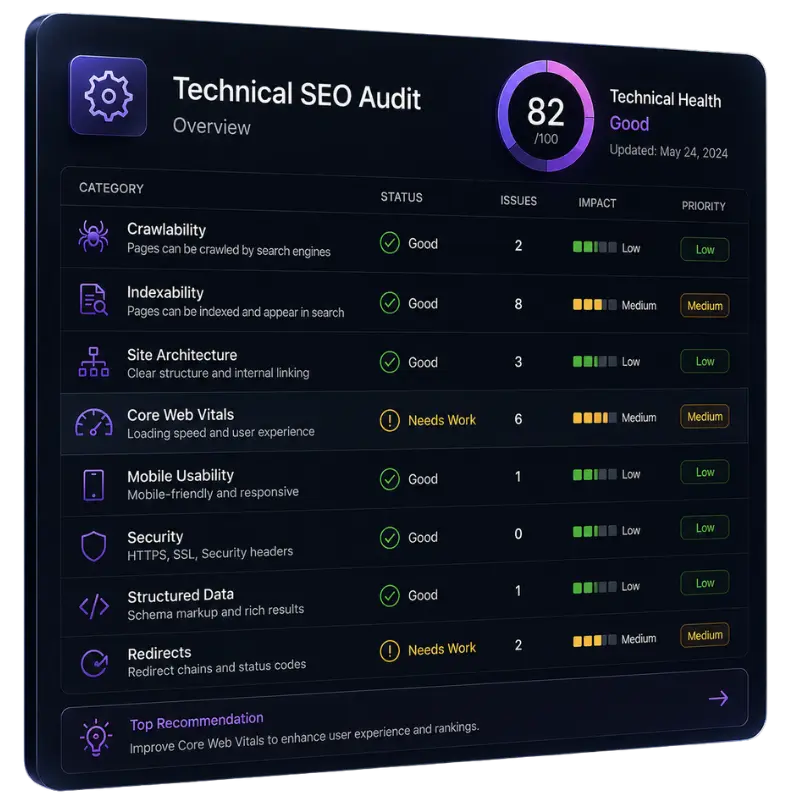
Every engagement opens with a full technical audit: crawl, log files, rendering, field data on Core Web Vitals, index coverage. That audit is not the deliverable. It produces a prioritized implementation queue, ranked by impact-to-effort ratio.
Then we implement it in your codebase or alongside your developers and verify each fix in Search Console before it is closed. If the diagnosis is all you need, our standalone SEO Audit is a separate product with a fixed scope and published pricing. If you need the work done, this is the page. Cior Digital runs both, and the rest of our SEO services connect to the same foundation.
A report is not a result.
Nothing is closed until it is verified.
DELIVERABLES
Eleven technical areas.
Six things we hand back.
Every item below is identified in the opening audit, ranked, implemented, and then verified. Nothing is marked done on the strength of a recommendation.
Crawl and Indexation Fixes
Robots directives, sitemaps and redirect chains resolved, orphan pages connected, index coverage errors cleared and resubmitted in Search Console.
Core Web Vitals Implementation
LCP, INP and CLS remediated against field data, not lab scores, following the Google Core Web Vitals documentation.
JavaScript Rendering and Hydration
Rendered DOM checked against source. Critical content moved out of client side only rendering wherever it blocks indexation.
Site Architecture and Internal Linking
Link equity flow mapped and crawl depth reduced, with hub and sub-service structure enforced consistently across the site.
Structured Data and Schema Markup
JSON-LD is implemented and validated in the Rich Results Test, aligned with what AI search engines parse when they decide who to cite.
Migration, Canonicals and Duplicates
Pre-migration audit and redirect mapping built before launch, post-launch monitoring, canonical conflicts and parameter duplication resolved.
The engagement also covers log file analysis, HTTPS and security headers, mobile-first compliance, crawl budget management, and penalty recovery where the site needs it.
NEXT
Where technical work connects
A clean technical foundation is what makes every other investment pay. Once crawling, rendering and indexation are solved, these are the areas that turn a healthy site into a growing one.
SEO Audit
Diagnosis as a standalone product, with fixed scope, published pricing and no implementation attached.
Explore SEO Audit →SEO Content Writing
Once the site can be crawled and rendered, content is what earns and holds the position.
Explore SEO Content Writing →Local SEO
The same technical foundation applied to local pack visibility and geographic queries.
Explore Local SEO →All SEO Services
The full SEO and GEO service line, from diagnosis to content to AI search visibility.
Explore All SEO Services →Rankings

Visibility
Qualified Traffic
Leads
Revenue
ENGAGEMENT
Three ways to work together
Technical work is not one size. Pick the shape that matches your site’s current state.
Technical SEO Sprint
One defined problem, one fixed window.
- Migration recovery
- Post-redesign traffic loss
- Core Web Vitals remediation
- Indexation emergency
Full Implementation
The complete engagement, audit through verification.
- Full technical audit and log file analysis
- Prioritized implementation queue
- Fixes implemented, not just recommended
- Verification in Search Console
- Handover documentation for your team
Ongoing Technical Retainer
For sites that ship changes every week.
- Continuous crawl and index monitoring
- Regression prevention on every release
- Core Web Vitals tracking on field data
- Monthly technical reporting
Scope is defined in the consultation. What it costs depends on the number of URLs, the complexity of your stack, whether a migration is involved, and whether we implement the fixes or hand the prioritized queue to your developers.
What clients say about the work

She created a beautiful, sophisticated website for us that really stands out from others in our industry. The SEO results have been excellent, and she’s always proactive in advising us on ways to improve. Any technical issue or communication challenge has been handled quickly and professionally. We couldn’t be happier with the work and would highly recommend her.

I have been working with this company for 4 years, and I am very happy. The results are excellent, and the service is personalized. I truly recommend them!

What can I say…Zol is one of the best professionals I have worked with. He gives everything and helps you with everything you need. 100% recommended.
Helpful Answers
Technical SEO questions
We get asked most
What do technical SEO services actually include?
Six areas of work: crawl and indexation fixes, Core Web Vitals implementation, JavaScript rendering, site architecture and internal linking, structured data, and migration or canonicalization control. The engagement also covers log file analysis, HTTPS and security headers, mobile-first compliance, crawl budget management, and penalty recovery when needed. Every item is identified in the opening audit, ranked by impact-to-effort ratio, then implemented and verified.
How is this different from an SEO audit?
An SEO audit is a diagnosis. It tells you what is wrong and in what order to fix it, then stops. Our SEO Audit is a standalone product with a fixed scope and published pricing. Technical SEO services include an audit as phase one, then implementing the queue and verifying each fix. If you have a capable development team and only need the map, take the audit. If you need the work done, take this.
How much do technical SEO services cost?
Four variables set the number: how many URLs the site has, how complex the stack is, whether a migration is involved, and whether we implement the fixes or hand the prioritized queue to your developers. A single sprint on a single defined problem sits at one end of the range; a full implementation on an enterprise site sits at the other. The scope is agreed upon in the consultation before any figure is quoted.
Do you implement the fixes or just deliver a report?
We implement. Reports are the industry default and the reason most technical audits sit unread in a shared drive. We work in your codebase or alongside your developers, and nothing is marked closed until the fix is verified in Search Console or in field data.
How long before technical fixes affect rankings?
It depends on the fix. Indexation and crawl corrections often show within days to a few weeks, because they change what search engines can reach. Core Web Vitals require a full field data cycle of roughly 28 days before the improvement is reflected. Architecture and internal linking changes take longer, since authority redistributes gradually. Nobody can guarantee a date, and anyone who does is guessing.
Does technical SEO matter for AI search and LLM citations?
Yes, and more than it did for classic search. An AI engine has to crawl the page, render it, and parse a clear structure before it can cite you. Sites that block crawlers, hide content behind client-side-only rendering, or ship no structured data are simply absent from generated answers. The same infrastructure rules apply, as set out in Google crawl budget guidance.
Do you work with WordPress, Shopify, or custom stacks?
Yes. WordPress work usually centers on plugin conflicts, bloated page builder output, and duplicate archive URLs. Shopify brings faceted navigation and near-duplicate product URLs. Custom and headless stacks bring rendering and hydration problems. The audit method is the same; the implementation path is different.
What happens when a site migration goes wrong?
Most migration losses come from redirect mapping done after launch rather than before. Recovery starts with a full crawl of the old URL inventory against the new one, then rebuilding the redirect map, resolving canonical conflicts, and resubmitting for indexation. Rankings usually recover over one to three months, depending on how long the broken state stayed live.